
Office Parking Costs: How Much Time and Money Do Employees Lose?
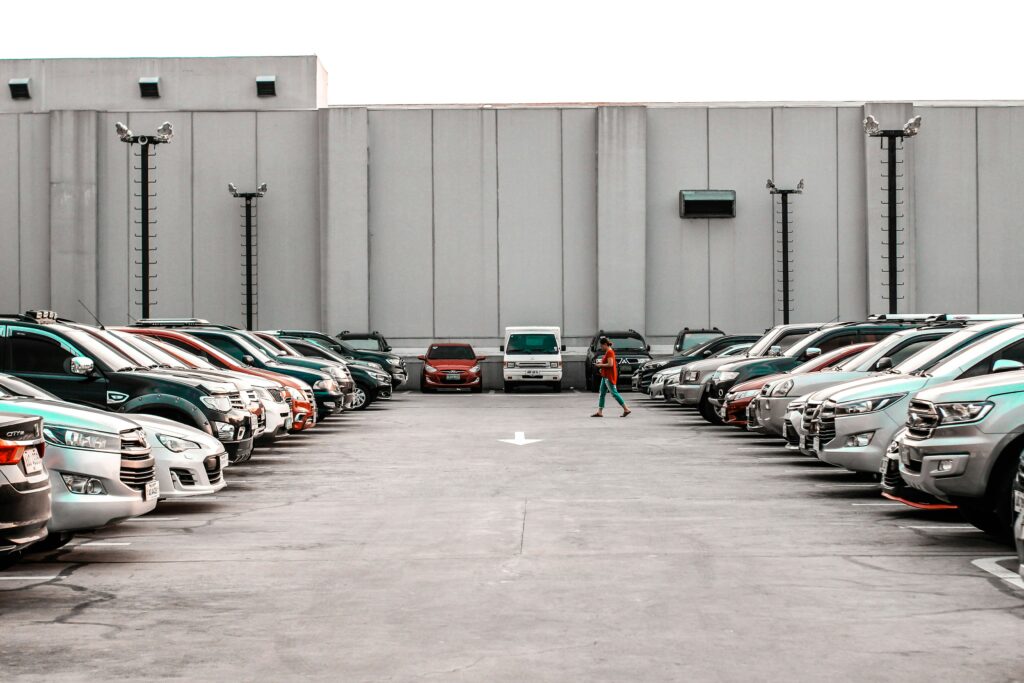
It’s 8:45. You’ve spent 30 minutes in traffic, your meeting starts at 9:00, and you pull into the office car park.
It’s full.
So the search begins.
You do another lap, check the nearby streets, find a paid spot three blocks away and walk back to the office. Twenty minutes later, you finally reach your desk. You are late, stressed and €24 poorer.
One bad morning may not sound like a serious workplace problem. But when it happens every week, and to dozens of employees, the cost adds up quickly.
And the frustrating part is that some parking spaces may still be sitting empty.
Why office parking becomes a daily struggle
When the car park is full, employees usually have a few options:
- Circle and wait. They spend extra time checking the car park and nearby streets.
- Pay for external parking. A city parking zone or public garage becomes the backup option.
- Leave home earlier. Some employees add extra time to every commute just in case.
- Park where they should not. Guest spaces, blocked cars or illegal parking create another set of problems.
- Stay home. If parking is consistently difficult, remote work becomes the easier choice.
Each workaround solves the immediate problem, but it costs time, money or convenience.
So what does one missed parking spot actually cost?
Let’s use a typical employee working in or near Vilnius Old Town.
For this example, we assume:
- Normal commute: 30 minutes
- Parking search and walking time: 20 minutes
- External parking: €3 per hour
- Working day: 8 hours
The €3 hourly rate is conservative. Vilnius Blue Zone currently charges €3.50 for the first hour and €4 for each following hour.
One missed office parking spot therefore adds 20 minutes to the commute and €24 in parking costs. Now assume the same employee experiences this twice a week across 44 working weeks.
At company level, we use a scenario where 30 employees miss a parking spot on an average working day, across 220 working days. To estimate the value of the time lost, we use an average employee cost of €15 per hour.
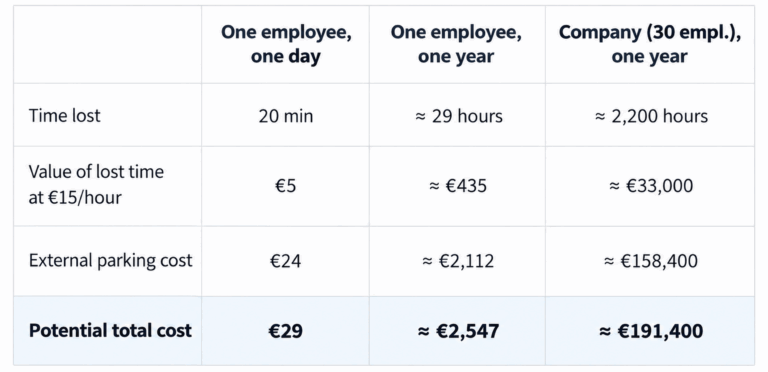
What starts as a €29 parking problem on one morning can add up to more than €2,500 per employee per year and become a six-figure cost at company level.
And this still excludes costs that are harder to measure:
- late meetings
- stressful starts to the day
- parking complaints and conflicts
- employees choosing to work remotely because parking feels unpredictable.
Parking search is not unique to Vilnius either. INRIX estimated that drivers spend around 44 hours per year searching for parking in the UK, while estimates for Germany put the figure at 41 hours.
The irony: the car park may not actually be full
This is where the problem gets more interesting.
While employees are searching nearby streets, some office spaces may still be unused.
That can happen because:
- an employee with a fixed space is working from home
- someone is on holiday but their allocated spot remains unavailable
- a parking reservation becomes a no-show
- a space becomes free but nobody else knows about it
So the problem is not always a lack of physical parking. Sometimes it is a lack of visibility and sharing.
Let’s continue with the same company.
It has 80 parking spaces.
If around 15% of them, or 12 spaces, remain unused on an average day because of no-shows or unavailable fixed spaces, the company already has part of the capacity it needs.
It just cannot use it efficiently.
How TableAir changes the parking flow
TableAir turns parking from a first-come, first-served system into a shared resource employees can plan around.
Instead of arriving first and hoping for the best, employees can see availability before starting their commute.
The system can help in several ways:
- Advance booking. Employees see available parking spaces and reserve one before leaving home.
- Parking linked to desk bookings. Parking can be prioritised for employees who are actually coming to the office.
- Check-in and automatic release. If someone books a space but does not arrive, it can return to the available pool.
- Shared fixed spaces. Management or assigned spaces can be made available when their usual users are away.
- Parking zones. Guest, EV, accessible and management parking can be managed separately.
- Occupancy data. Office managers can see demand, no-shows and the busiest days.
One Lithuanian ministry introduced TableAir parking booking specifically to solve employees’ daily problems with arriving at work and finding a parking space. Another client highlighted a simple benefit: when employees know in advance that parking is unavailable, they can choose another way to travel before leaving home.
The goal is not necessarily to guarantee everyone a parking spot. It is to remove the uncertainty and use existing capacity better.
TableAir parking booking is priced per parking space rather than per user. See current pricing.
What happens if 12 unused spaces return to the pool?
Let’s go back to the same 80-space car park.
If better booking, automatic releases and shared fixed spaces make 12 additional spaces available each day, fewer employees need to use external parking.
Employees also no longer need to spend time searching for a space they will not get.
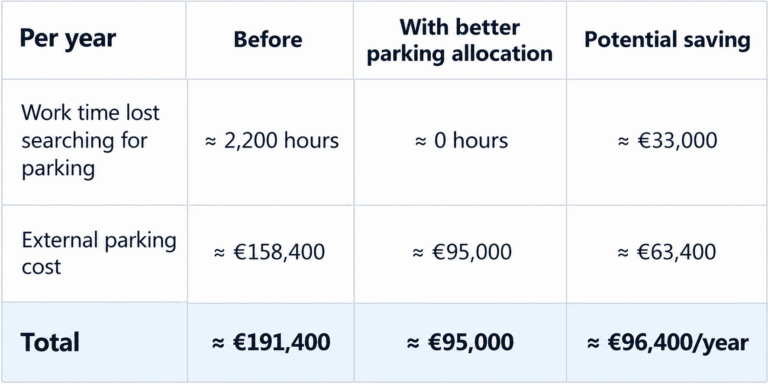
Better allocation does not suddenly create enough parking for everyone. But in this scenario, it reduces the potential annual cost by around €96,400 simply by making better use of spaces the company already has.
For an employee who previously missed a space twice a week, that also means getting back almost four working days a year and potentially cutting external parking costs significantly.
Better parking management solves more than parking
The financial calculation is only part of the benefit.
Better parking management can also help companies:
- Use existing space better. Occupancy data shows whether more parking is genuinely needed or whether existing spaces simply need to be shared more effectively.
- Reduce conflicts. Clear booking rules replace arguments over fixed or occupied spaces.
- Make office days more predictable. Employees can plan their commute before leaving home.
- Improve guest experience. Visitor parking can be reserved in advance.
- Remove one reason to stay home. Parking becomes less of a barrier to coming into the office.
Key takeaways
- One missed parking spot can cost an employee 20 minutes and €24.
- If it happens twice a week, that becomes around 29 hours and €2,112 per year before counting the value of lost time.
- At €15 per hour, the total annual impact is about €2,547 per employee.
- If 30 employees experience the same problem every working day, the potential annual cost can exceed €190,000.
- In our example, 12 of 80 parking spaces are already available but underused.
- Making those spaces accessible again could reduce the annual cost by around €96,400.
The answer is therefore not always more parking.
Sometimes it is simply better management of the parking you already have.
Is parking the #1 complaint in your office?
See how TableAir’s office parking booking solution works, or request a free demo to calculate what better parking management could save your company. Let’s talk.
Related reading: 7 Parking Management Tactics for a Stress-Free Environment