

It’s Friday, 10 a.m. Mark is standing in the middle of the office, coffee in hand, looking at rows of empty desks.
He manages the office of a 100-person tech company. On Tuesdays, finding a free desk is almost impossible. Today, he counts just 14 people. The other 86 desks are empty.
The lights are on, the heating is running, and the cleaners came yesterday evening. All that empty office space costs exactly the same as it does on a busy Tuesday.
Sound familiar? Hybrid offices often have two very different sides: crowded midweek and almost empty on Mondays and Fridays. But the rent doesn’t change depending on how many people show up.
So, what can companies actually do with empty office space they’re still paying for?
This is an illustrative scenario. Mark, Laura and the freelancers are fictional, but the situation and figures reflect a typical hybrid office.
The real cost of empty office space
Mark’s company rents 1,000 m² in Vilnius at €15 per m². That’s €15,000 a month, or €180,000 a year.
Fridays account for roughly one-fifth of the working week. So, around €36,000 of the annual rent can be attributed to Fridays, when about 85% of the office is empty.
When Mark showed the numbers to Laura, the CFO, her first question was obvious:
“So, can we just rent a smaller office?”
Unfortunately, it wasn’t that simple.
Their lease had three years left, and the office was genuinely full on Tuesdays and Wednesdays. Subletting part of the space long-term would leave employees without desks on busy days. Closing the office on Fridays wasn’t an option either, since some teams and visitors still needed access.
And doing nothing meant continuing to pay for desks that were barely being used.
The problem wasn’t that they had too much space. They had too much space on Friday and not enough on Tuesday.
Then Mark had another idea.
What if someone else used those empty desks?
Mark belongs to a local freelancer community. Almost every week, someone asks where they can find a quiet place to work with good Wi-Fi, without paying coworking prices.
Looking at the empty office, he wondered: why not let freelancers use the desks the company is already paying for?
His proposal was simple. Open a separate zone of 30 desks on Fridays, charge €15 per day and offer meeting rooms for another €15 per hour. The rest of the office would remain reserved for employees.
Freelancers could book through the same booking system employees already used. No need for another platform or complicated arrangements.
The building manager had no objection, provided the company obtained the necessary written approval from the landlord.
How would it work in practice?
Mark chose 30 desks near the entrance and kitchen, away from teams handling sensitive information. Employees kept their usual workspaces, while freelancers had a clearly defined area.
Bookings were made in advance, so Mark always knew how many guests to expect. On arrival, freelancers registered as visitors, with their entry and exit times recorded.
Guest Wi-Fi was separate from the company network, restricted areas stayed off-limits, and meeting rooms could be booked by the hour.
Mark also introduced a few simple house rules covering clean desks, shared spaces and kitchen etiquette.
The idea was to make better use of the office without creating extra work or disrupting employees.
Let's look at the numbers
After three months, Mark prepared an annual revenue estimate for Laura, assuming 45 Fridays a year to account for holidays.
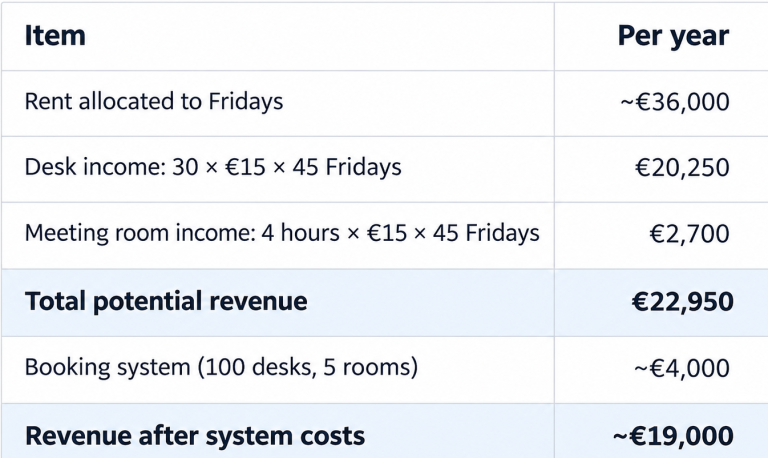
At full occupancy, the company could generate almost €23,000 a year from space that would otherwise sit largely unused. After covering the annual booking system cost, that’s around €19,000 before other expenses and taxes.
That’s more than half the rent allocated to Fridays, and enough revenue to cover the annual booking system cost more than five times over.
And what if only half the desks were booked?
Even with 15 freelancers every Friday, desk bookings alone could generate around €10,000 a year. That’s still more than twice the booking system cost.
Of course, these are example figures. Actual revenue depends on demand, pricing, taxes and operating expenses. But they show how unused office space could become an additional source of income.
What about security, taxes and employees?
Laura liked the idea, but she had a few concerns.
First, the lease. Many landlords restrict subletting or third-party use, so Mark checked the conditions and obtained written approval before moving forward.
Security was another priority. Guests stayed in a designated zone, used separate Wi-Fi and registered on arrival. Teams working with sensitive information remained in restricted areas.
The company also needed to handle invoicing, applicable VAT and insurance. Its insurer confirmed that guest access could be covered with a small policy adjustment.
And the employees? Mark asked them before introducing the change. Most were happy with the arrangement, especially since their own workspaces remained unaffected.
Some even enjoyed having more people around on Fridays. Two developers ended up working on a side project with a freelance designer they met there.
What happened next?
Three months later, the Friday zone was regularly about two-thirds full, with a short waiting list during busy weeks.
Looking at the office occupancy data, Laura asked:
“If Fridays work, what about Mondays?”
And that’s the bigger lesson. Once you understand how your office is used, day by day and desk by desk, you can start making better decisions about the space you’re already paying for.
Other ways to use an empty office
Renting desks to freelancers is just one option. Depending on your company and lease, you could also:
- Share space with a partner company or subsidiary on quieter days.
- Host events, workshops or meetups in the open space after hours or on Fridays.
- Offer desks to clients or suppliers who visit regularly.
- Consolidate quiet days onto one floor and reduce heating, lighting and cleaning costs on the others.
- Use occupancy data to renegotiate your lease, so you know exactly how much space you need when it’s time to renew.
The right approach depends on how your office is used. And that’s where having reliable data makes a difference.
How TableAir helps
Everything in Mark’s case depends on knowing what’s actually happening in the office and controlling who can book what.
With TableAir, you can:
- Create booking zones and decide who can book them and when. For example, employees only from Monday to Thursday and guests on Fridays.
- Register and track visitors, so you always know who’s in the building.
- Manage meeting room bookings with clear rules, displays at the door and automatic release of no-shows.
- Use check-ins to automatically free up unused reservations.
- See real occupancy and attendance data, with heatmaps showing which days and zones are actually being used.
The result? An office that makes better use of what you’re already paying for, whether that means reducing costs, generating extra income on quiet days or both.
Is your office half empty on some days? See how TableAir’s workplace analytics and visitor management work, or request a free demo to find out what your empty desks could be worth.
Related reading: Office Space Utilisation: The Key to Cost Savings